
Publication Alert: More Protein Improves Survival, Growth, and Fecundity and Reduces Cannibalism in Yellow Mealworms
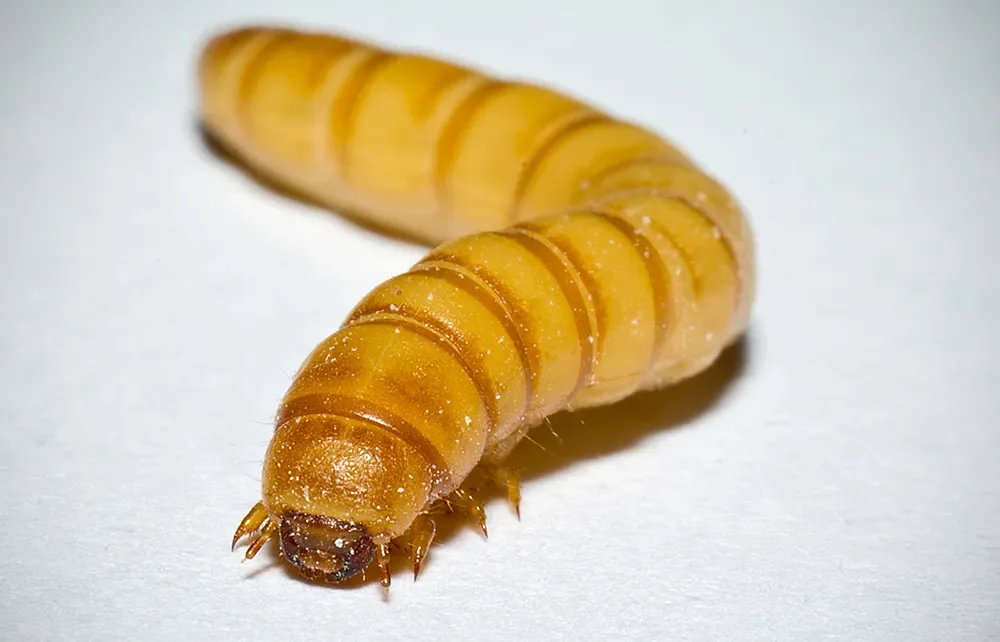
Yellow mealworm larvae (Photo credit: Flickr/AJC1, CC BY-SA 2.0)
High Protein Diets Early in Life Improve Survival, Reduce Cannibalism, and Increase Growth and Yield in Farmed Yellow Mealworms (Dobrowolski and Perl, 2026; Applied Animal Behaviour Science)
Conflicts of Interest: Durosaro is an Assistant Development Officer at the International Society for Applied Ethology (unpaid). Barrett is the Director of the Insect Welfare Research Society (unpaid); serves on the publications committee of the Royal Entomological Society (unpaid); and is a Co-PI at the Center for Insect Biomanufacturing and Innovation.
Yellow mealworms (Tenebrio molitor) are one of the most widely farmed insects in the world, with an estimated 290 billion reared annually. Many standard diets recommend primarily wheat bran. We know from self-selection studies that yellow mealworm larvae prefer close to a 1:1 protein-to-carbohydrate ratio, and that wheat bran, at 13–18% protein, falls meaningfully short of that target. We hypothesized that this low level of protein could explain the high rates of cannibalism observed in some mealworm populations: mealworms may be getting that additional protein from the bodies of the other larvae in their bin.
The consequences of that hypothesized protein shortfall are the subject of this paper. We wanted to understand whether supplementing the typical wheat bran diet with 20% nutritional yeast — bringing it up to a protein level more similar to what larvae self-select — would improve survival, growth, and yield for larvae (and fecundity for adults) and reduce cannibalism for larvae across their development. We were also interested in whether the timing of that protein supplementation mattered.
The short answer: yes, and the earlier, the better.
Larvae on the high-protein (HP) diet grew dramatically faster than those on the standard low-protein (LP) diet, with HP larvae reaching slaughter weight (100 mg/larva) earlier and reaching adulthood on average 13 days faster. In our early-vs-late protein timing experiment (weeks 0–4 vs. 4–8), larvae that received HP diets early grew fastest regardless of what they were fed later — early nutrition set the trajectory.
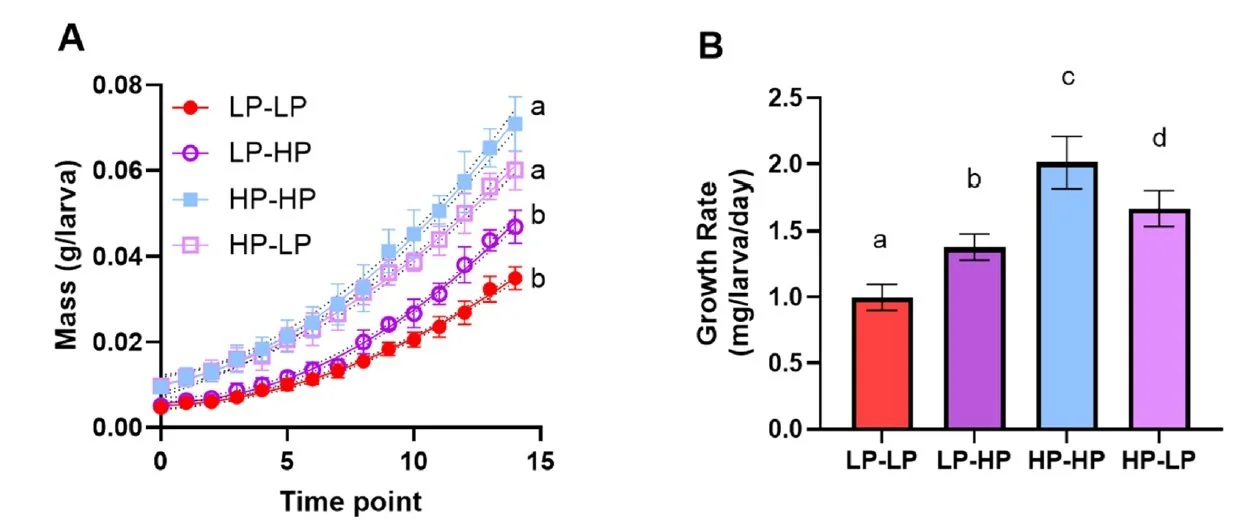
Early life and current diet affect the growth rate of YML (LP = low protein; HP = high protein; before the - is the early life diet for weeks 0 - 4 of development, after the dash is the current diet for weeks 4 - 8). A) Overall models of growth rate in each condition differed based on both early life diet and current diet. Letters indicate statistically significant differences in growth rate among treatments. B) Average growth per larva per day was highest in the HP-HP treatment, then the HP-LP treatment, then LP-HP, and finally LP-LP. Letters indicate statistically significant differences.
Low-protein diets of just wheat bran early in life reduced survival and increased cannibalistic behaviour. Larvae on HP-HP diets throughout had 93% survival versus 70% on LP-LP, and nearly 3× the total biomass at eight weeks. Cannibalism — which carries welfare costs like cuticular damage, infection risk, and mortality and may spread disease more rapidly to the still-living larvae — was significantly reduced by protein supplementation, especially when that supplementation happened early.
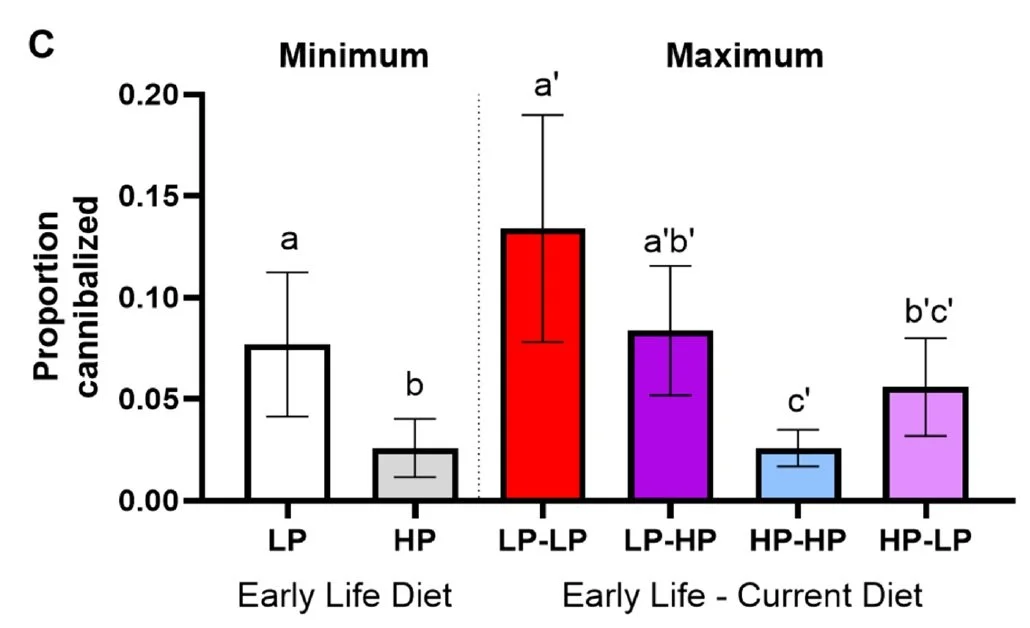
Effects of early life on two methods of measuring cannibalistic behaviors in yellow mealworms (minimum, left; maximum, right). LP early life diets increase the likelihood of cannibalism. The minimum possible proportion of larvae cannibalized (direct evidence of cannibalism only) was decreased by HP diets early in life. The maximum possible proportion of larvae cannibalized (direct and indirect evidence of cannibalism) was decreased by HP diets currently [week 4 - 8] and early in life [week 0 -4]. Letters indicated statistically significant differences (p < 0.05) among conditions on a graph.
Adult fecundity was also positively impacted by the high protein diet. Providing a HP diet to adults — even those that had been raised on LP diets as larvae — increased the number of offspring per female by 34–36%. And larvae raised on HP diets produced more offspring even when switched to LP as adults. Protein matters across the life cycle.
What are the main takeaways for producers?
Protein supplementation is highly beneficial — Higher protein diets dramatically improve growth rate, survival, biomass yield, and reduce cannibalism.
Early life protein matters most. If supplementation across the full larval period is cost-prohibitive, prioritising the first four weeks of larval life is likely to give producers the most return on investment in terms of welfare and yield.
Adults benefit too. Adding more protein to adult diets is a relatively low-cost way to meaningfully improve fecundity — even if larvae were not supplemented.
Standard wheat bran alone is unlikely to be sufficient for yellow mealworm welfare, and prior recommendations of at least 20% protein in the diet remain a reasonable minimum starting point though this study suggests it’s possible that more benefits could be seen at even higher levels of protein supplementation.
Want to read more news from the lab?