
Publication Alert: Relatively Bigger Eyes, But Worse Sight? The Paradox of Visual Investment in Centris pallida Males
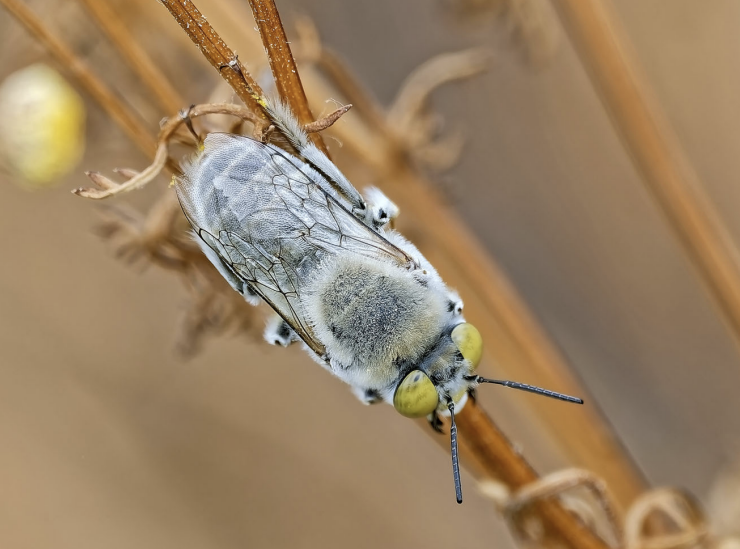
Adult Centris pallida small morph male (Pierre Deviche (CC-BY NC) iNaturalist, observation 350382398.)
Sex, Head Size, and Male Mate Location Behavior Affect Allometric Scaling of the Eyes in Centris pallida (Hymenoptera: Apidae) Bees (Barrett & O’Donnell 2026; Integrative Organismal Biology)
This paper features one of my favorite study animals and asks one of my favorite kinds of questions: does investing relatively more in a sensory structure actually translate into better performance?
Not necessarily.
From my prior work, readers will know that male Centris pallida come in two morphs with very different mate-finding strategies. Large-morph males use scent to find females emerging from underground natal nests. Small-morph males primarily use sight to find females flying in the air. Given that behavioral division, you’d expect small-morph males — the visual specialists — to have better eyes and visual acuity. And in a sense, they do invest relatively more in them: small-morph male eyes scale hyperallometrically with body size (meaning their eyes grow disproportionately large relative to their heads as body size increases), while large-morph male and female eyes scale hypoallometrically. Small-morph males also have greater ommatidia density relative to eye surface area which could suggest better resolution.
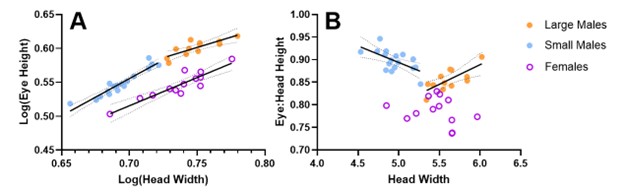
Small males (blue) have eyes that scale hyperallometrically while large males (orange) have eyes that scale hypoallometrically. Females in purple.
But here’s the catch: despite that increased relative investment, small-morph males end up with worse visual acuity than large-morph males. They have fewer total ommatidia, smaller average ommatidia diameters, and significantly larger inter-ommatidial angles — both locally (in the dorsofrontal acute zone) and globally. And it’s body size that’s driving this: small-morph males are simply smaller, and allometric constraints on eye size and curvature mean they can’t match the visual performance of their larger counterparts, no matter how hard they scale.
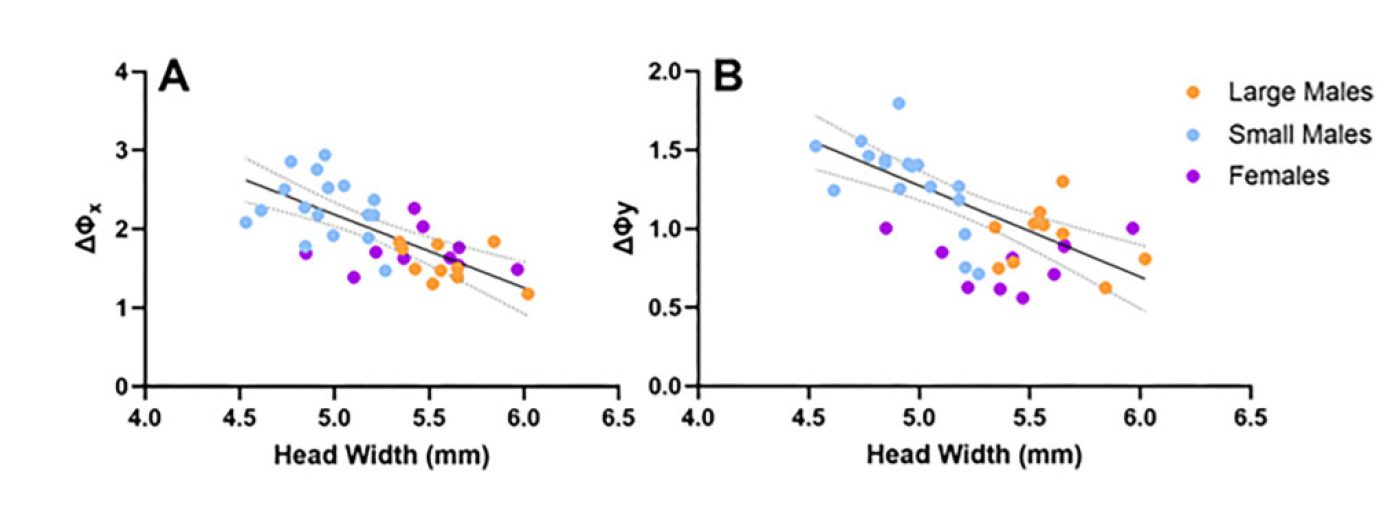
Horizontal and vertical localized interommatidial angles decrease with body size in males, where smaller angles tend to mean increased visual acuity.
The comparison with females is also interesting. Females have smaller eyes and fewer ommatidia than size-matched males, but their average localized visual acuity in the dorsofrontal hotspot is actually comparable to large-morph males — and better than small-morph males. Unlike males, females’ visual acuity doesn’t change with body size, suggesting the allometric constraints operate differently between the sexes.
Ultimately what this tells us is that behavioral specialization doesn’t automatically correlate with the most adaptive morphological phenotype — allometric constraints can prevent that from happening. There’s also a conservation-relevant result worth noting: my prior work shows that C. pallida male body sizes, for both large and small morph males, have been declining over the last five decades. If body size continues to shrink, male visual acuity could be significantly compromised. Understanding the functional consequences of these body size shifts is an important open question.
Want to read more news from the lab?