
Publication Alert: Not All Brains Are Built Equal (Brain Cell Counts in C. pallida)
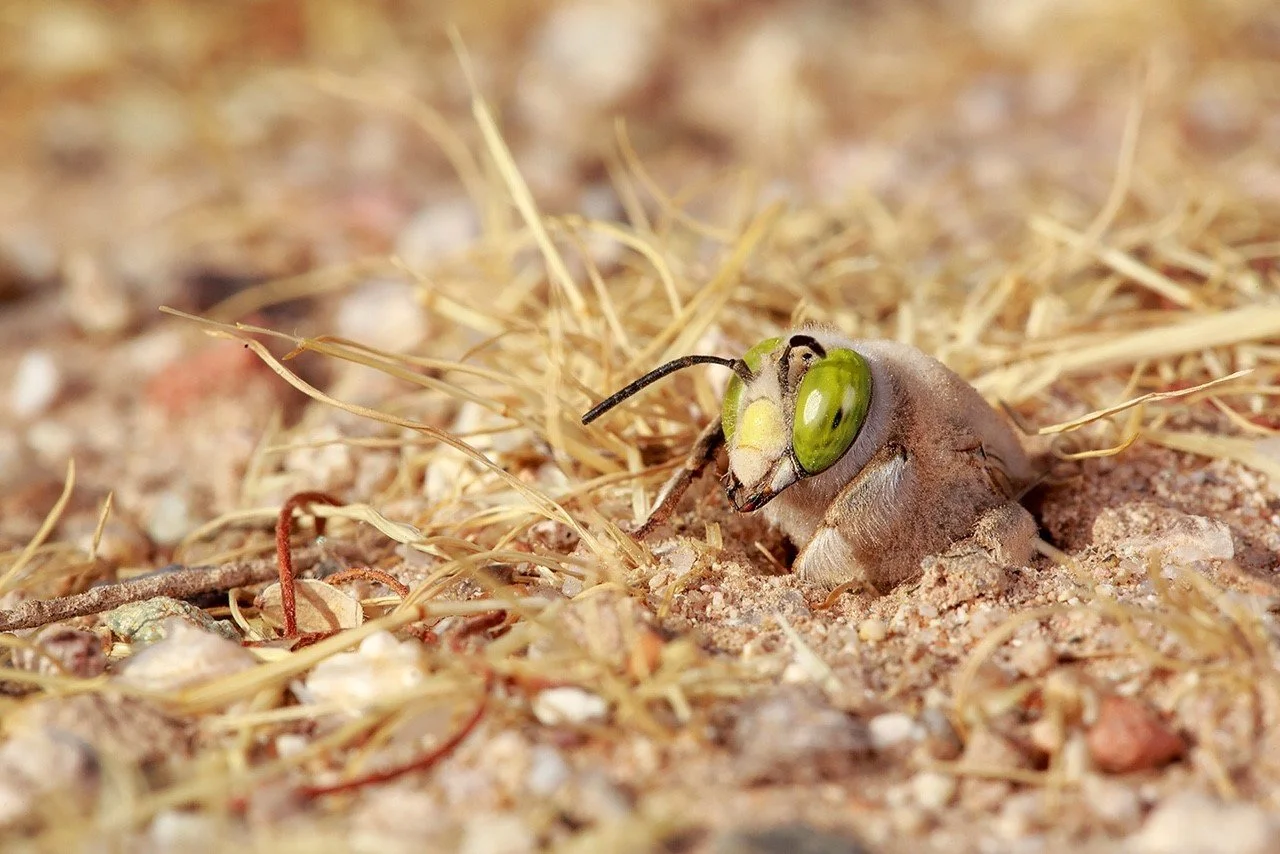
Adult male Centris pallida - credit Bruce Taubert
Sex- and Male-Morph-Specific Variation in Brain Mass and Cell Number Scaling in Solitary Centris pallida (Hymenoptera: Apidae) Bees (Barrett & Godfrey 2026; Journal of Comparative Neurology)
This paper has been a long time coming — it brings together two of my favorite threads of research: the fascinating alternative reproductive tactics of Centris pallida males, and the question of what it actually means, at a cellular level, to “invest” more in a brain region.
We already know from my prior work in this system that male C. pallida bees come in two distinct morphs with totally different mate-finding strategies. Large-morph males patrol the ground and locate females by scent. Small-morph males (tend to) hover near vegetation and find females visually. Correspondingly, we’ve shown before that large-morph males have bigger antennal lobes, and small-morph males have relatively bigger optic lobes. But all of that work was on relative volume — we had never actually looked at how many cells were in those regions. Here, we’ve delved into total brain cell counts, and cell counts in the optic lobes, for male and female C. pallida.
We found that female C. pallida bees have bigger brains and more brain cells and higher cell densities than size-matched males. Females’ OL mass scales much more steeply with body size than males’, and females have substantially more cells in their OLs at equivalent brain sizes. Females also always have larger CBs with more cells than males of the same size (but neither sex shows a strong change in CB cell number with brain size).
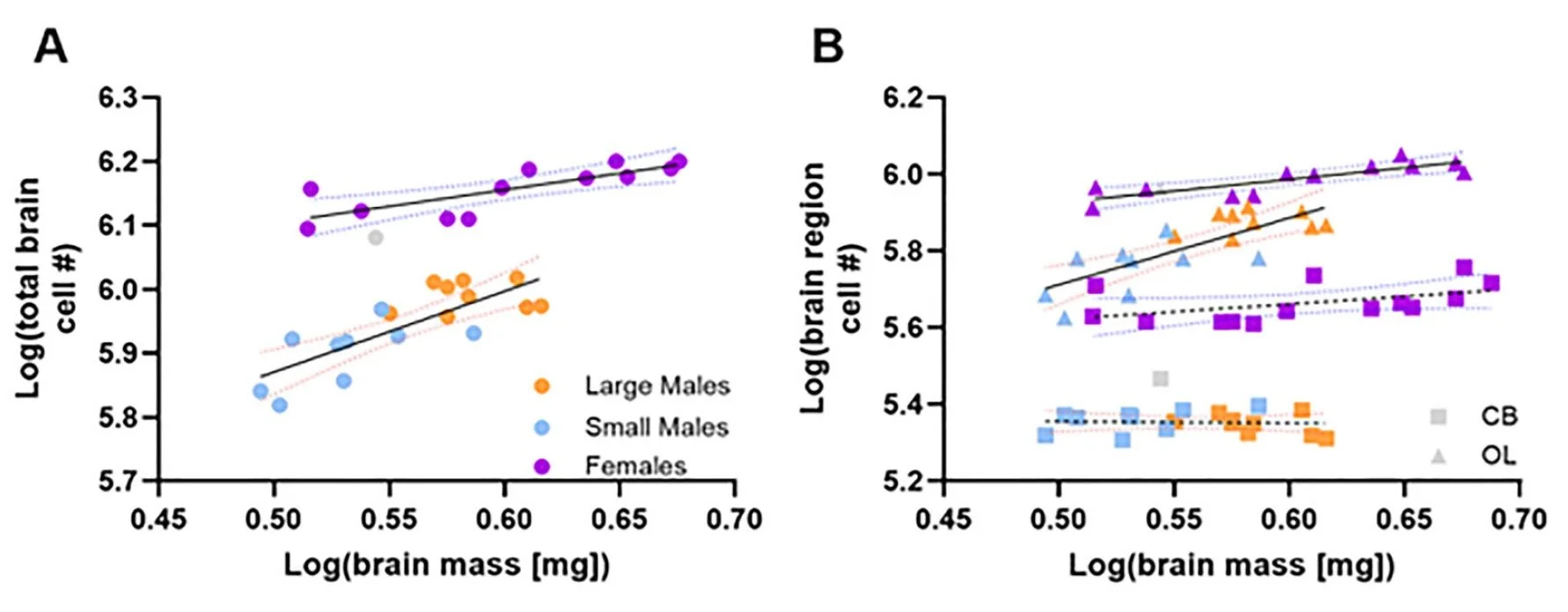
Brain cell numbers scale differently with brain size in male and female Centris pallida. (A) Total brain cell numbers scaled hypoallometrically with brain mass in females and hyperallometrically in males. (B) CB (central brain) cell numbers did not change with brain mass in either males or females, though females had a greater number of cells than males. Female OL (optic lobe) cell numbers scaled hypoallometrically with brain mass, and male OL cell numbers scaled hyperallometrically.
There were also difference between the two male morphs using the alternative reproductive tactics. Small-morph males have relatively larger OLs by mass. But they actually have fewer OL cells than large-morph males, and lower OL cell density. So a larger-seeming optic lobe, by volume or mass, doesn’t necessarily mean more cells — and cell density is not constant across brain regions or individuals.
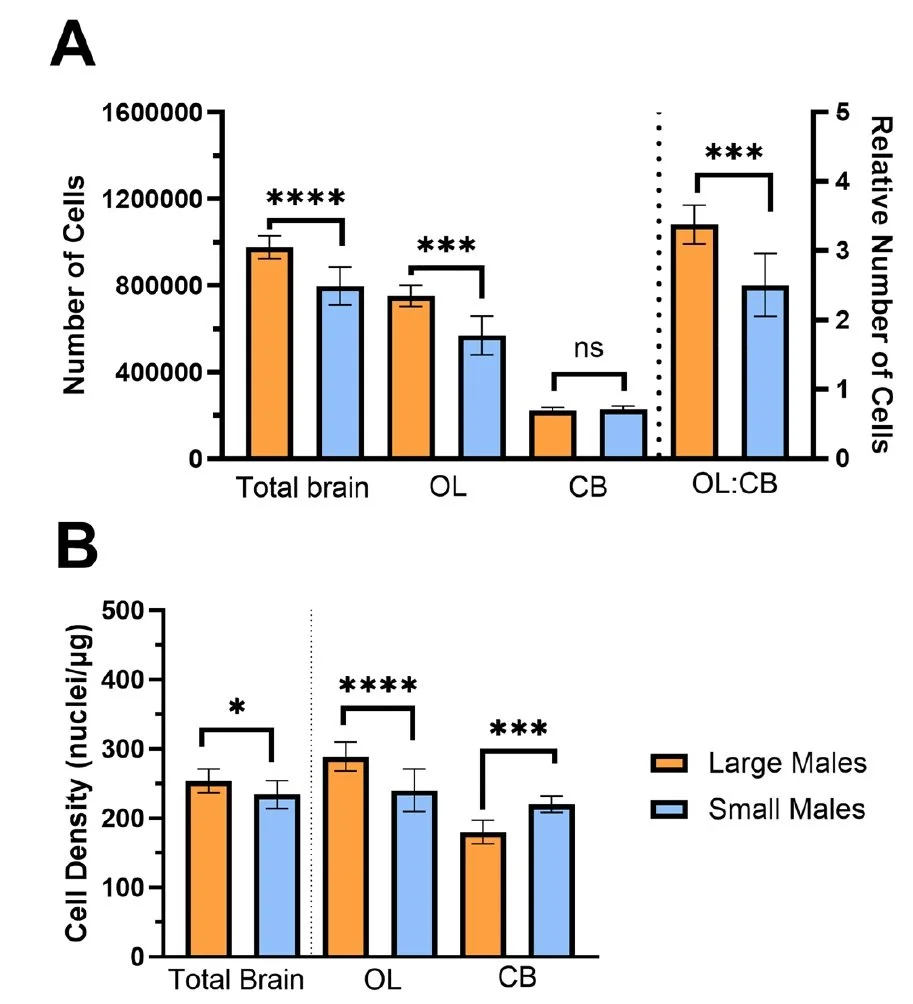
OL and CB cell numbers, and cell densities, in male Centris pallida bees. (A) Large-morph males had more cells in their whole brain than small-morph males, driven by increases in the number of OL cells, as there was no difference in the number of cells in the CB between morphs. (B) Large-morph males had denser OLs, but less dense, than small-morph males, resulting in a slightly denser brain overall. Means with error bars representative of standard deviations. * = p < 0.05; *** = p < 0.001; **** = p < 0.0001
What does this mean? At a minimum, it tells us that brain tissue volume and brain cell number can be decoupled — which has important implications for how we interpret neuroanatomical variation in insects. Volumetric investment in a brain region is not the same as cellular investment, and both matter for understanding sensory and cognitive performance. Whether small-morph males compensate for fewer OL cells with larger cell size, or whether large OL cells in small-morph males reflect a different kind of neural processing efficiency, remains to be worked out.
Want to read more news from the lab?